
London Calling
Two muse studios transforms a Georgian landmark in London.
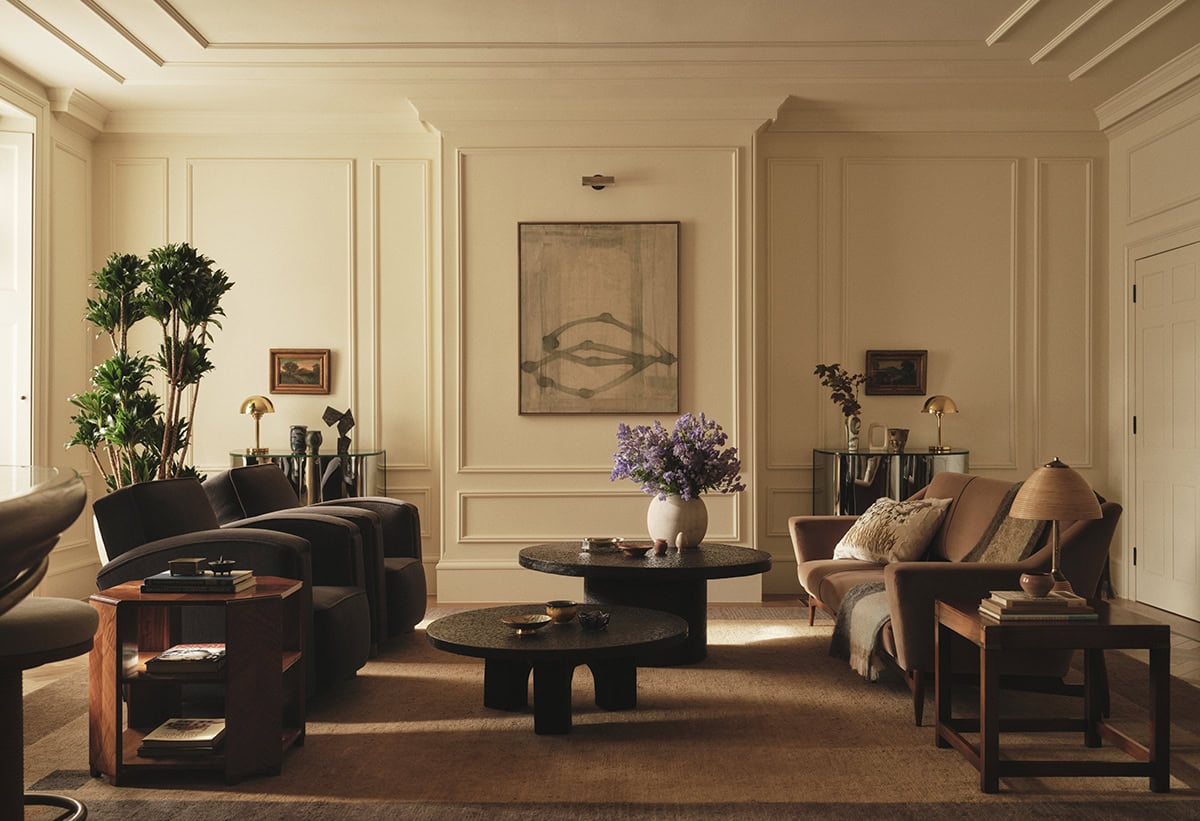
The lounge spans the full width of the building’s front facade, its wall of windows overlooking the garden square below. Vintage European furnishings, layered textiles, and a curated mix of brass and nickel lighting create an atmosphere closer to a private club than an office.
When Los Angeles–based Two Muse Studios was commissioned to transform an entire floor of a mid-18th-century town house in London’s St. James district, Alexa Lameiras and Katelyn Pascavis started where they always do—with the building itself. “We believe strongly that the architecture of a project has a large influence on what the interior design should be,” the duo says. “Because of this, we really leaned into the surrounding neighborhood, London, and Europe in general.”
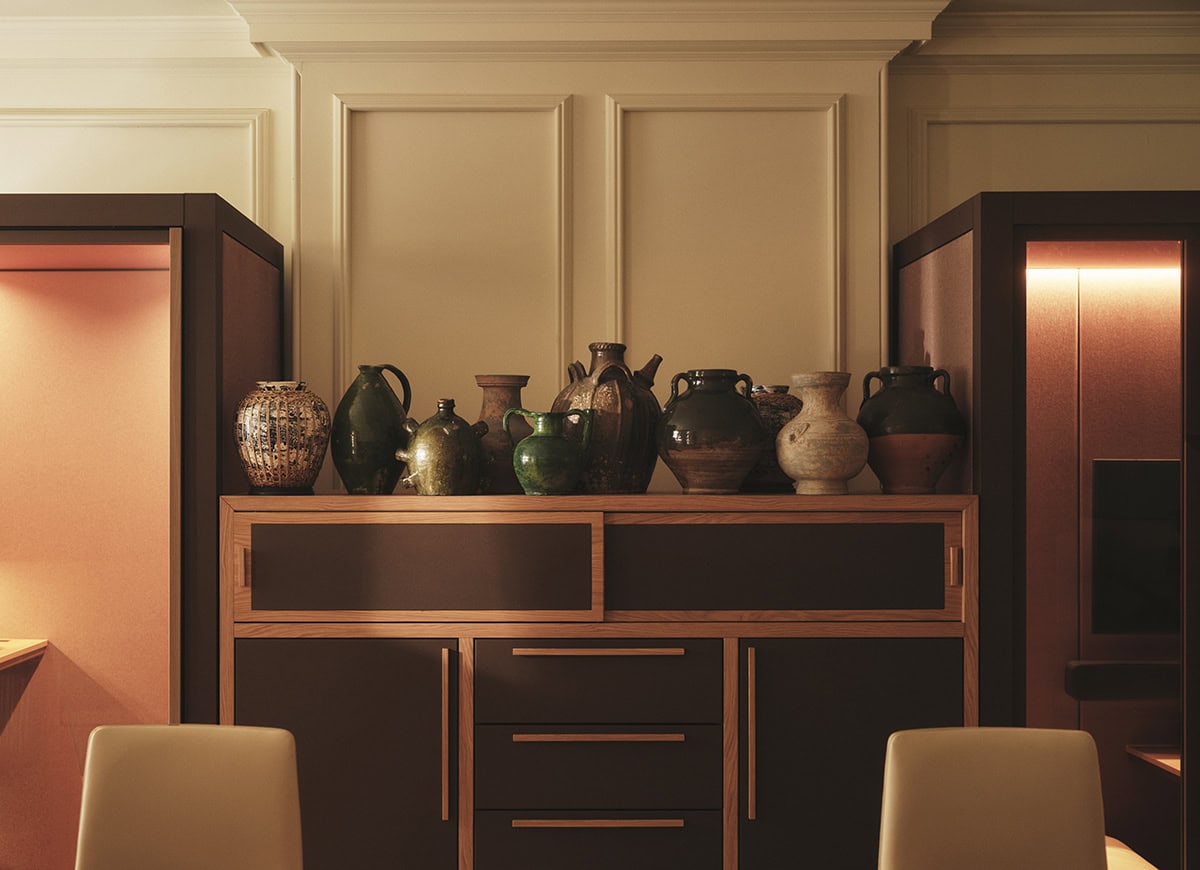
A collection of vintage pottery crowns the custom storage paneling above.
The result is a 3,200-square-foot workspace that feels less like an office and more like a beautifully appointed private club. The client, a boutique firm that cabinet, its warm, earthy forms echoing the linear patterns of the Georgian uses the space for both daily operations and high-level investor meetings, wanted a space that could move seamlessly between workaday utility and impressively chic without missing a beat. “They wanted it to exude luxury,” Alexa and Katelyn note, “a high-end space where high-end work is done.”
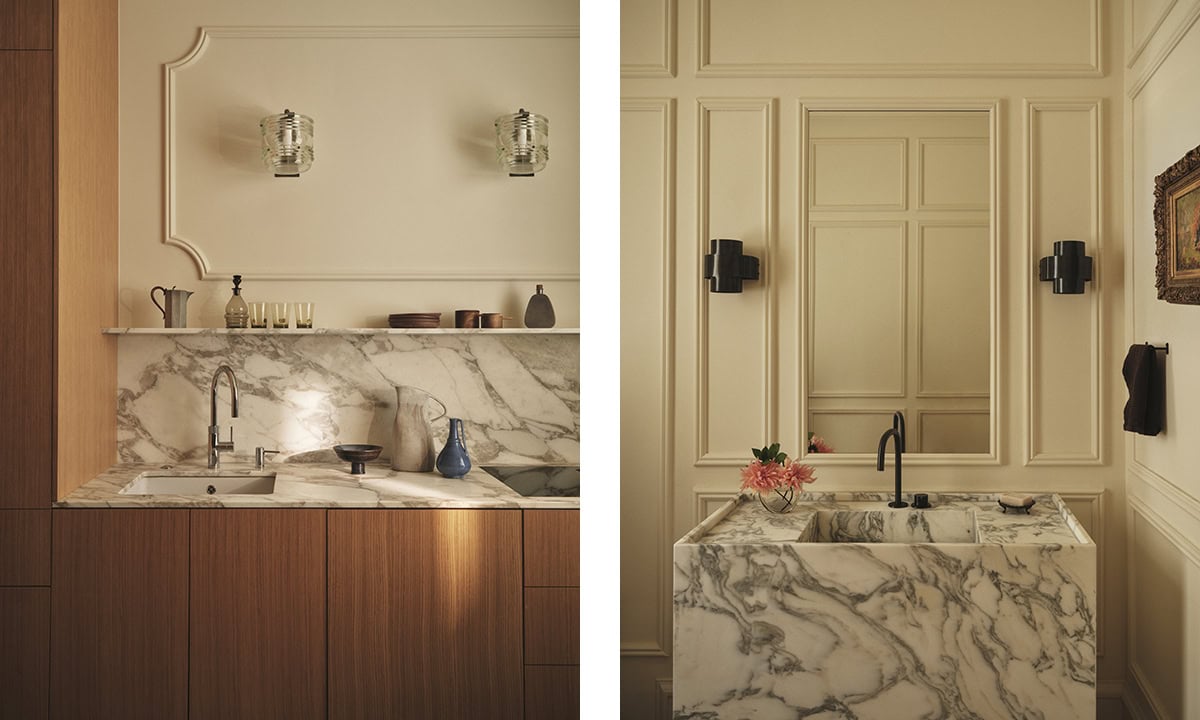
Left: Calacatta Vagli Oro marble surfaces the kitchen countertops and backsplash, its luminous veining complemented by vintage Italian sconces and seamless custom oak cabinetry. Induction cooktop by Gaggenau.
Right: The powder room’s custom Verde Arni Extra marble vanity — a monolithic slab carved to form both basin and surround — is flanked by sculptural sconces.
The building itself—a Grade II–listed property dating to 1748–1751, originally designed by architect Matthew Brettingham the Elder—was as much a brief as it was a mood board. The palette draws from the neighborhood’s own vocabulary: neutral earth tones echoing the Georgian stonework, soft muted greens pulled from the garden square outside, and deliberate flashes of red nodding to the city’s iconic phone booths. All vintage furniture was sourced from European merchants; bespoke pieces were crafted locally by British makers whose craftsmanship, the designers say, left them genuinely inspired.
“We believe strongly that the architecture of a project has a large influence on what the interior design should be.”
Materials were chosen with the same nuanced care. Solid oak flooring and custom millwork provide warmth; three varieties of honed marble surface the bar, powder room, and kitchen. Leathers upholster the work areas, while suede, wool, alpaca, and mohair layer in texture and softness. Unlacquered brass fixtures are left to patina naturally over time—it’s a detail that won’t read as designed, which is, of course, the whole idea.
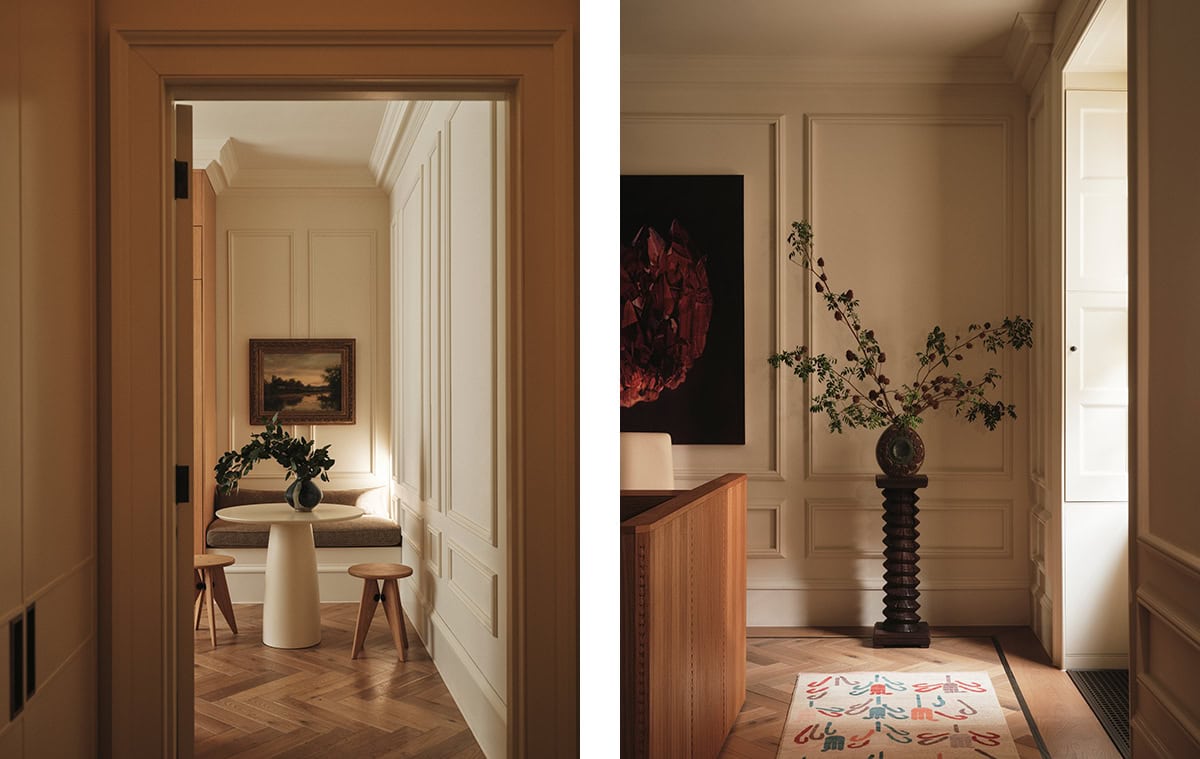
Left: An ikebana-style arrangement holds court in one corner of the lounge, illuminated by natural light. The oak flooring is topped by a rug whimsically populated with stylized tulips on a neutral ground.
Right: A built-in banquette transforms an intimate alcove into a quiet retreat, which features a lacquered dining table and carved benches.
“Furniture, buildings, and cities with age carry history, soul, and stories,” Alexa and Katelyn say. “We get to help them continue that story in a way that feels relevant to today.”
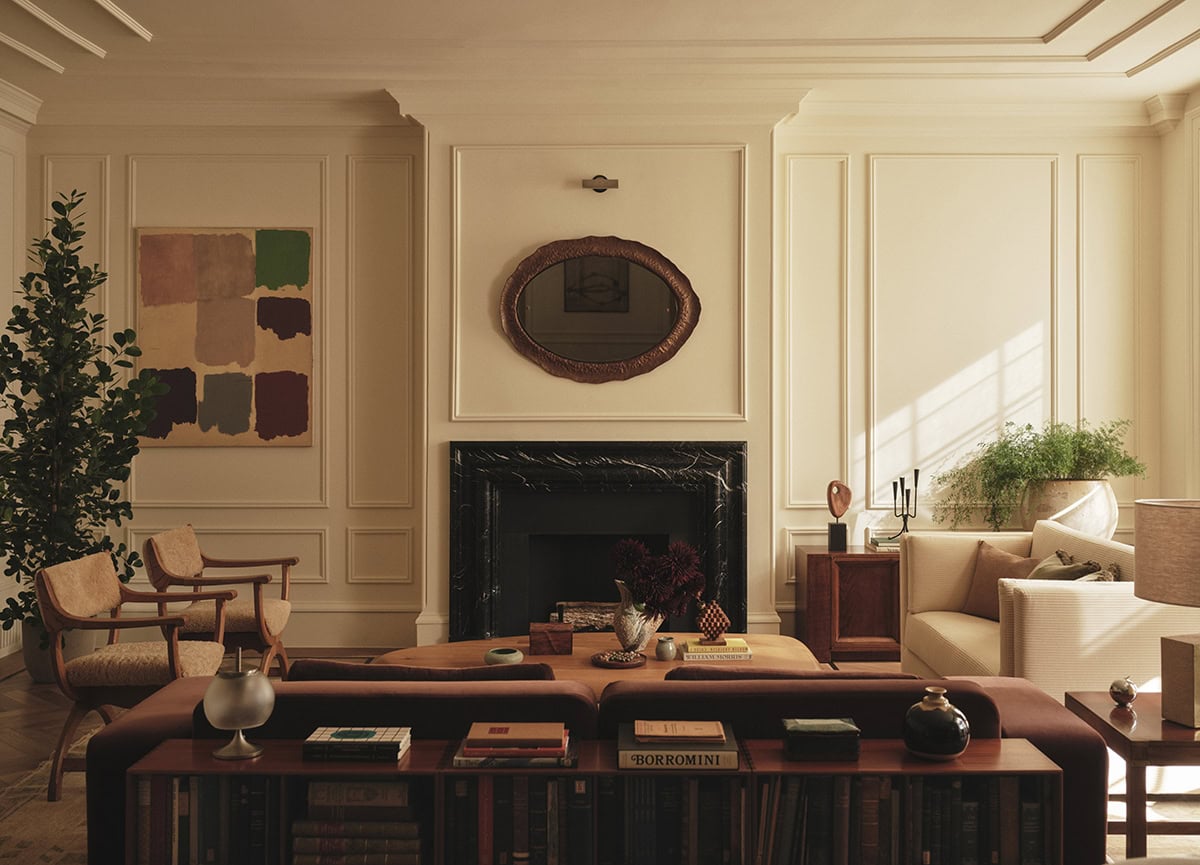
The beautiful symmetry of the living room is a hallmark of Georgian architecture. The designers chose a palette of neutral earth tones and muted greens, inspired by natural stone and the colors of the park just outside.